Willie Keith
The Caine Mutiny Court-MartialWillie Keith is the novel’s central character, and the story turns on the distance between the life he imagines for himself and the responsibilities he gradually accepts. A Princeton musician and literature graduate, he enters naval service with romantic expectations and an appetite for escape. The Caine instead subjects him to error, discipline, fear, and command. His development is measured not by a single conversion but by repeated tests: whether he will admit failure, whether he will speak when silence troubles him, and whether he can act when the ship and its people are in danger.
Identity and Formation
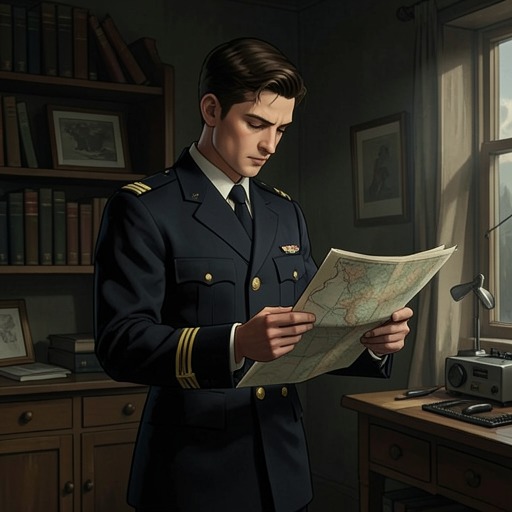
Willie is introduced as a medium-height, somewhat chubby, good-looking young man, with curly red hair and an expressive face whose humor is more noticeable than any conventional air of strength. He graduated from Princeton University in 1941 with high marks except in mathematics and the sciences. Comparative literature was his academic specialty, but piano playing and writing songs for parties and shows had occupied more of his college life. His artistic ease and social charm are part of his identity; they have not yet been matched by experience of sustained responsibility.
The narration likens the story’s beginning with Willie to a great vault door turning on a small jewel bearing: the large events to come pivot on his character. That image suits a protagonist who initially seems light in substance beside the war and naval institution surrounding him, yet whose choices become the hinge of the plot. He does not begin as a practiced leader. He begins as someone who has seldom tested his abilities and who must discover, under pressure, what he can and cannot do.
His reluctance to commit himself to service is tempered by a belief that he should find out whether he is any good. Even the possibility of transfer to the Army seems preferable to remaining uncertain about his own capacities. His decision to proceed is therefore both practical and personal: military service becomes a test of a self he has largely formed in the protected, cultivated setting of college.
From Princeton to the Caine
When Willie receives orders to report to the receiving station in San Francisco for transportation, the prospect of naval life becomes immediate. His father’s counsel gives that transition a moral dimension. A message urges him, at the crossroads of his life, to choose better than a father who believes he took wrong turns; elsewhere, Dr. Keith writes in the margin of a Bible that the message concerns Willie’s work on the Caine and wishes him luck. The advice makes the ship more than a posting: it becomes one of the places where Willie’s decisions will be tested.
His first impressions of the Caine are sharply unfavorable. He sees a filthy wreck and privately resolves not to become accustomed to it or take pride in it. He sets himself a limit of six months and expects to get off the ship, partly because he believes an admiral is fond of him. That calculation reveals both his ambition and his habit of treating the Navy as a temporary obstacle to the life he prefers. When Captain de Vriess is followed by Captain Queeg, Willie initially welcomes the change as deliverance and expects the new commander to improve his prospects.
The lost action dispatch makes his inexperience consequential. When he returns it to Captain Queeg, Willie admits that the loss resulted from his own stupidity and carelessness. He cannot offer an excuse or a more complete explanation. His failure is not abstract: it is an operational lapse for which he is responsible, and it gives his father’s written counsel about the Caine a more immediate weight. In another early glimpse of his romantic cast of mind, he anticipates the Caine’s departure for Pago Pago as the beginning of adventure, imagining the literary associations of Somerset Maugham and the possibility of submarines. Even in uniform, he initially interprets danger through stories and prospects of personal redemption.
Work, Discipline, and the Limits of His Understanding
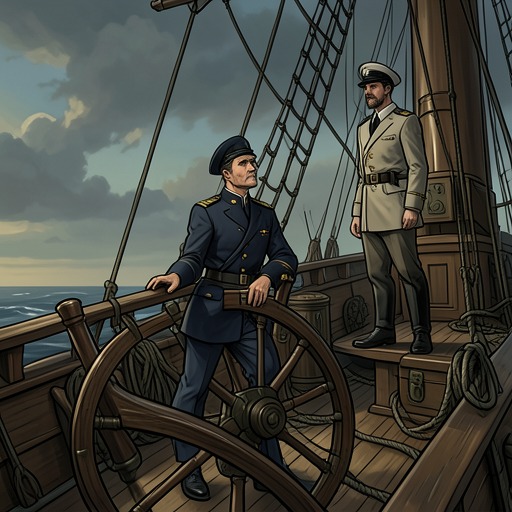
Willie’s progress is uneven but real. On a noon-to-four watch as officer of the deck, with Tom Keefer available to correct mistakes and Captain Queeg observing from his chair, he conducts a faultless watch. The task is straightforward: maintain station in the screen while a convoy zigzags. Yet the successful watch matters because Willie manages to keep his uncertainty from disrupting his performance. He handles the ship firmly and records the watch in the log, taking a concrete step into the duties he had once imagined only as a route to something else.
His understanding of command does not develop at the same pace as his competence. During a bombardment, he watches from the flying bridge as a spectator, smoking and whistling while the attack appears almost like a spectacle. Tom Keefer’s question about whether Willie has seen Captain Queeg on the bridge jolts him: he realizes that he has not. He had been puzzled by the captain’s movements but had not drawn the implication Keefer raises. The episode exposes the difference between seeing events and interpreting them. Willie is physically present in a combat setting, yet his attention and judgment have not caught up with what that setting demands.
His unease also grows around the conflicts within the ship. When Willie asks Keefer what to put in a written report concerning Urban’s shirttail, the issue shows how Queeg’s regulations reach into small matters of appearance and how Willie is drawn into their administration. Later, suppressing knowledge of Rabbitt’s orders weighs on him; at dinner he watches Steve Maryk and feels implicated in a crime. Rather than treating obedience as effortless, the narrative shows how the expectation of silence can divide his conduct from his moral judgment.
The pressure becomes personal after the Stanfield episode. Queeg’s attention shifts from Keefer to Willie, who becomes the wardroom’s new target. Keefer presents him with a cardboard goat’s head, transferring a shipboard emblem of ridicule. The captain’s repeated summons and interruptions to Willie’s sleep make discipline an intimate, exhausting routine rather than an occasional reprimand. Willie joins in the laughter at the goat, but his wry participation does not undo the burden of being singled out.
Relationships, Fear, and Choice
Willie’s relationship with May Wynn offers a different test of judgment. When the Caine backs into the channel, he sees May waiting at the pier and recognizes her at once. She is dressed for travel, watching the ship; when she sees him, she waves, and he returns the gesture while trying to maintain the composure of an officer. His response is deeply personal, but he contains it in a small public action. The scene joins his romantic life to his naval identity: he is departing as one of many officers, yet the exchange makes that departure particular to him.
He later proposes to May while feeling vertigo and struggling to speak. The proposal is framed by his fear that he is a monster for whom she might nevertheless accept a life together. At home, however, his confidence collapses. He recognizes that guilt influenced the proposal, suspects that he has misunderstood her willingness to marry, feels ashamed of her background, and cannot imagine her as a partner in the academic life he expects for himself. He is unsure whether he loves her and feels more trapped than eager. His mother is present when he asks to end the discussion. The episode reveals a painful division between the intimacy he desires and the social and intellectual standards by which he judges a possible future with May. He eventually jilts her, and the later memory of that choice becomes one of the clearest measures of what he has lost.
The water famine tests a different kind of courage. Willie privately considers going to the chaplain on the Pluto to tell the story, but gives up the plan. He tells his reflection that he is Lieutenant Keith of the Caine and does not have to go weeping to someone else. The decision is not evidence that the problem has vanished; rather, it shows him trying to bear his position without appealing for relief. His assertion of identity is both a form of resolve and a limit he imposes on himself.
During the typhoon, Willie loses his bearings as Steve Maryk takes a maneuver he cannot understand. With water around him and his faith in the ship gone, he looks to Maryk as if the executive officer might save them by magic. The scene strips away any easy idea of competence: Willie is present on the ship but cannot grasp the logic of the action unfolding around him. His fear is not resolved by a sudden mastery of navigation. Instead, it becomes part of the experience through which he learns how little an officer’s title can guarantee when the sea overwhelms ordinary understanding.
Crisis, Testimony, and Maturity
The court-martial forces Willie to revisit his place in the events of the typhoon. He follows counsel into the courtroom, where the flag and the solemn faces seem overwhelming, and finds himself sworn as a witness before he can fully take in how he arrived there. Jack Challee asks whether he was officer of the deck during the forenoon watch on December 18. Greenwald then begins cross-examining him by asking whether he disliked Captain Queeg. The questions put Willie’s professional observations and personal feelings into the same public account. Steve Maryk is acquitted after the court deliberates for an hour and ten minutes, a verdict that establishes the seriousness of the dispute over command without making Willie’s own role disappear.
A kamikaze attack brings a more intimate reckoning. As the aircraft closes on the Caine, Willie thinks not first of professional standing but of May. The prospect of death makes his regret at having failed to marry her feel final and undeniable; since jilting her he has tried to push thoughts of her aside, but now he believes he may never see her again. The emotional reversal does not erase the earlier doubts that led him to break with her. It shows instead that the value of the relationship becomes unmistakable to him under the pressure of possible loss. A letter addressed to May follows in the surviving evidence, though its contents are not given here.
After the strike, Willie returns to the pilothouse. He sees the wheel swinging freely, gets power humming, and uses the public-address system to speak to the decks. These are specific, practical actions in the aftermath of the attack: instead of remaining only a witness to danger, he moves toward the ship’s operation and addresses the crew. Later, with a dead sailor’s cigar smoke around him, he thinks about death, life, luck, and God. The narrator marks the change as lasting: the young man who lit the cigar is gone by the time Willie crushes the stub. Reflection here follows action and loss; it is not a general philosophical pose but an alteration in how he understands his own life.
Tom Keefer’s account of abandoning ship sharpens the contrast between intellectual analysis and responsibility. Keefer describes himself as trapped by the fact that he jumped and unable to forget it without resorting to the self-protective distortions he associates with Queeg. Willie’s wartime experience now includes not only his own fear but also a clearer view of how another officer lives with a choice. The exchange does not make Willie the judge of Keefer; it gives him a closer understanding of the moral burden that can persist after a crisis has ended.
Command and Departure
When news of Japan’s surrender is delayed, Willie, like other officers, calculates his chances of leaving the Navy. He nevertheless keeps a stiff face and pushes the ship’s routine forward while the crew relaxes. He is annoyed and amused by the new officers clustering around the wardroom radio, and he hears the ship’s doctor repeatedly claim that the government is withholding the news to keep reservists in service. Willie’s response is notably steadier than his early expectation of escape: he can recognize the crew’s impatience and still maintain the work in front of him.
The demobilization point system arrives in early September. It releases half the Caine’s crew and Captain Queeg; Willie’s own exit date is set for November 1. Keefer asks whether he is ready to take over the ship, placing command before him just as the prospect of departure has become definite. Willie later haunts the radio shack, carries an action message to the wardroom, and decodes it hastily. The available account establishes his involvement in handling the communication, not its contents. Together, these moments show that his approaching release does not immediately free him from the ship’s work or its command responsibilities.
At the Caine’s decommissioning, Willie hands over the cabin keys and records, signs the last logs, and has his bags taken to the dock. He sends the wrapped union jack to Horrible’s parents. Once his chores are done, he walks down the abandoned gangplank without saluting: there are no colors to salute and no officer of the deck. The Caine is junk. The ending places his departure beside the ship’s disappearance from service, closing the setting that has tested and altered him. Willie’s story begins with an expectation of quick escape and ends with the completion of duties aboard a vessel that has become obsolete. His maturation lies less in an uncomplicated triumph than in having learned to act within uncertainty, to carry the memory of choices, and to keep work moving even as his naval life comes to its end.